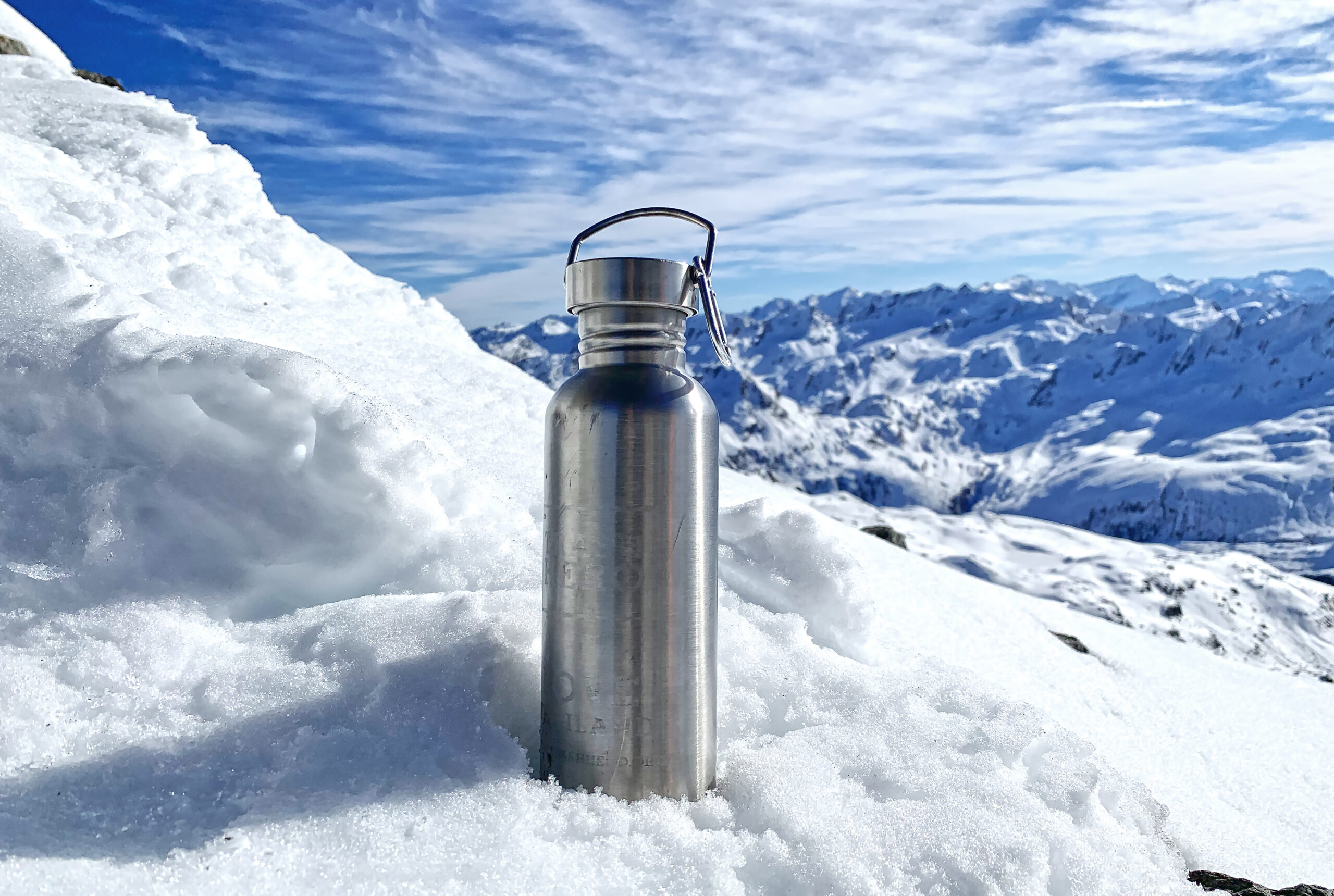
We all know that switching to reusables instead of single-use for everyday items like cutlery, food packaging and water bottles avoids a lot of plastic. Reducing waste and pollution is usually the main motivation for people who choose to reuse.
In addition to this, a recent study has also quantified the climate positive impact of the Trash Hero reusable bottle, by avoiding the greenhouse gas emissions associated with single-use plastic, as well as the money saved in the long term.
In 2019, René Mettler, a masters student at ETH Zürich, carried out research into the cost-efficiency of reusables vs. single-use systems of delivery. In one of the case studies, he compared the carbon footprint of consuming single-use plastic bottles of drinking water with refilling a Trash Hero stainless steel bottle with the equivalent amount of water at a hotel in Thailand. It was shown that the reusable system not only avoided plastic waste, but also reduced costs and greenhouse gas emissions. [René Mettler (2019). How to tackle the plastic crisis – a project-based cost efficiency assessment.]
How this was worked out
The study looked at the full life cycle of the two types of packaging systems only, not the water used to fill them. “Full life cycle” means: extraction of materials, production, use, disposal and any recovery of materials.
300 “usage cycles” were measured for each option, i.e. 300 single-use plastic bottles vs. 300 refills of the Trash Hero bottle.
The calculations were made using the following key assumptions:
- Plastic bottles come in a standard weight and size (600ml, made up of 17.4g mixed plastics).
- A fixed amount of water, heated to 60°C, is used for cleaning the reusable bottles and the 20 litre reusable drinking water tanks used to fill them. Note: the study was conducted in Thailand where it is not possible to drink water from the tap.
- Emissions from transport are neglected as they are expected to occur within both systems on a comparable level and to be relatively small overall.
- All plastic bottles get recycled at the end of their life.
This last is a very generous assumption, given that global recycling rates for PET bottles are around 25% and far less in many countries. It means that the figures used are very conservative.
 A more likely scenario for ‘end of life’ is that the bottles end up either in landfill, burned openly or in an incinerator to “recover energy”, or discarded on land or in water (the bottles pictured, left, were collected at a single Trash Hero beach cleanup in Koh Lanta, Thailand).
However, it was decided not to include these options in the calculation. The range of factors that determine any waste management scenario is very wide and much depends on the local context. Singling out any one could lead to the relevancy of the data being questioned. Instead, plastic bottles are given the fairest possible chance, with some material always being recovered.
The researcher has however confirmed that taking into consideration the more likely end-of-life alternatives would always lead to an increase in the calculated carbon footprint of plastic bottles. This is in addition to the negative health impacts caused by disposal and incineration, both of which release toxic chemicals (in the form of ash, fumes or microplastics) into the atmosphere and food chain.
Crunching the numbers
Working with the above assumptions, and rounding to the nearest gram, the study found that a single use plastic water bottle creates approximately 56g of CO2 emissions during its short life.
Meanwhile, the Trash Hero bottle and a reusable container used to dispense drinking water together release about 909g of CO2. But of course these bottles can be – and are – reused. Refilling a Trash Hero bottle generates only 2g of CO2 emissions – around 28 times less than drinking from single-use plastic.
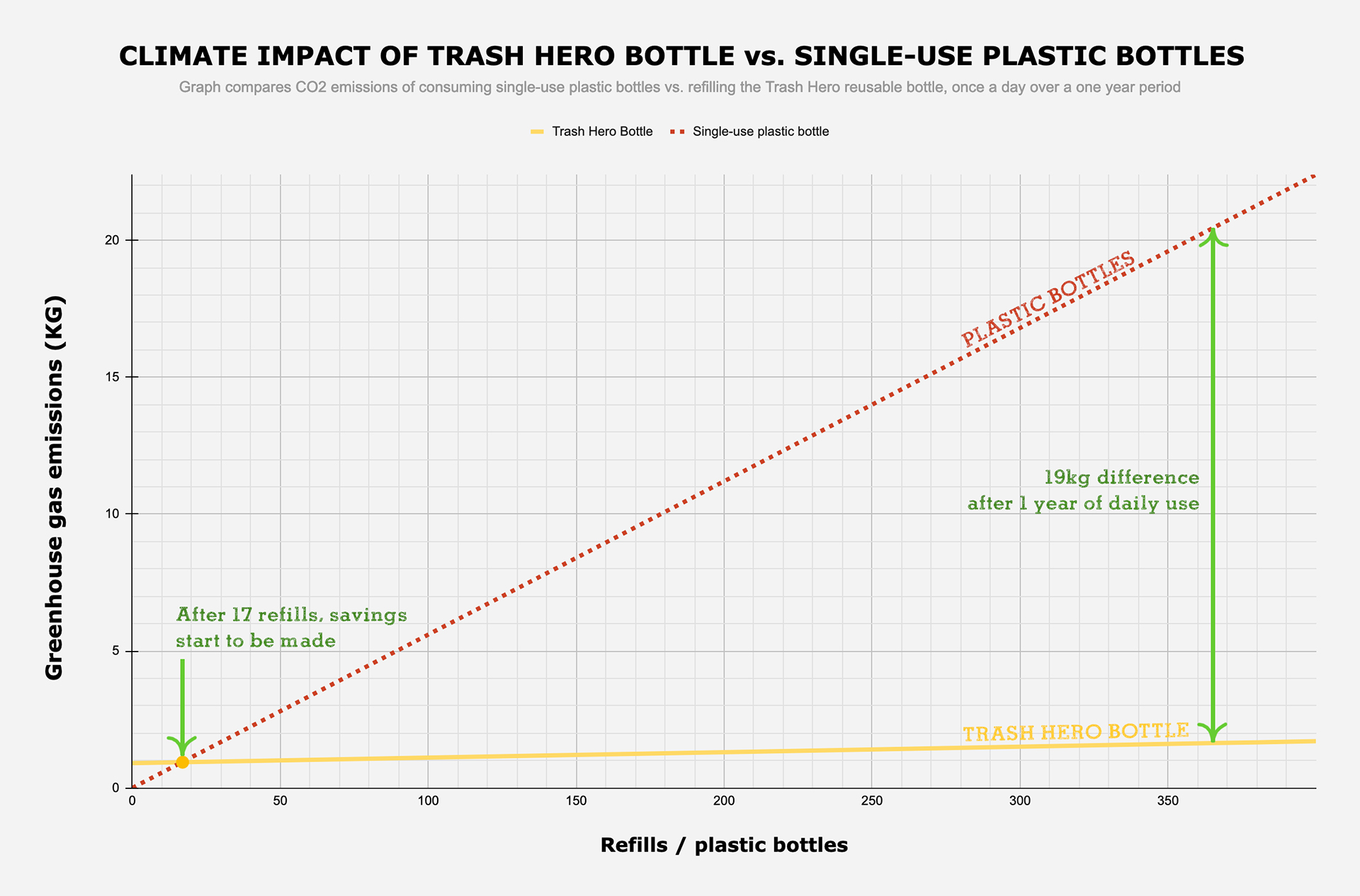
Using these numbers, we can say that after only 17 refills, the Trash Hero bottle starts to have a positive effect:
➤ 1 Trash Hero bottle + 17 refills creates: (909g) + (17 x 2g) = 943g CO2 emissions in total
➤ 17 single-use plastic bottles create: 56g x 17 = 952g CO2 emissions in total
So when you switch to a Trash Hero bottle and refill it 17 times, the greenhouse gas footprint is already less than that of the 17 single-use plastic bottles of drinking water you would have used instead. Any further refills result in a “saving” of CO2 as more plastic bottles are avoided.
This net saving is equal to 56g – 2g = 54g of CO2 every time you choose to refill rather than purchase a plastic bottle of water.
Over one year, if you refill once per day and avoid buying any plastic bottles of water, you will have reduced your CO2 footprint by just over 19kg!
Of course, this is actually a very small percentage of your overall annual carbon footprint – try not to drive to the refill point or order a steak with your water! – but as a direct comparison between packaging systems, the Trash Hero reusable option reduces your impact by around 95% vs. single-use plastic.
The conclusion
This is the first climate impact study done on the Trash Hero bottle and our refill programme. In the particular case considered, at a hotel in Thailand supplying drinking water to its guests, the reusable delivery system had a significantly lower rate of carbon dioxide emissions (95% less) than single-use plastic bottles, with sustained use (more than 17 refills).
In terms of the overall carbon footprint of an individual, the impact of switching to reusable bottles from single-use is likely to be very low, especially factoring in other activities such as transport or diet. However in the context of packaging and delivery systems, the climate positive impact of using the Trash Hero bottle is clear. At scale, small changes such as this can become important. A report in Science Daily in 2019 notes that “emissions from plastics will reach 17% of the global carbon budget by 2050.”
We also know that switching to the Trash Hero bottle reduces plastic waste and saves you money by avoiding bottled water. So we can say for our bottle, these are the new 3 Rs:
 REDUCE plastic waste
REDUCE climate impact
REDUCE costs
To work out exactly how much you could reduce, or already have, we have created two bottle impact calculators, linked to this study. The first is for individuals and the second is for hotels to work out the savings made by replacing plastic water bottles in their rooms with the reusable Trash Hero bottles. Give them a try: you may be surprised at the results!
————
René Mettler’s Master Thesis was jointly supervised by the Swiss Federal Institute of Technology in Zurich (ETH Zürich) and the sustainability solutions provider, South Pole. It analysed the cost efficiency of waste management and reusable packaging projects. One of these projects was the Trash Hero bottle programme, as implemented in a hotel in southern Thailand. The results showed that the bottle programme does not only lead to environmental benefits such as avoided plastic waste and CO2 emissions, it also saves costs. Our thanks to volunteer Caroline Schweisgut-Heimgartner for her help with interpreting the data.
read more