
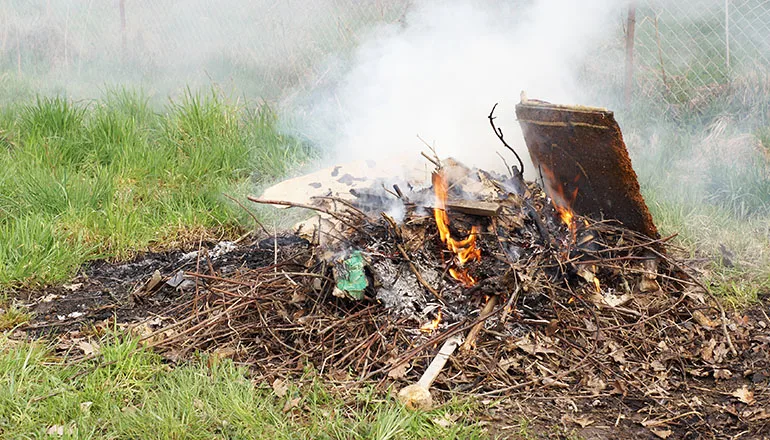
What would you do if your waste was not promptly collected in your area?
One day passes, and it starts to smell. One week passes, and it begins attracting pests and stray animals. When the rain comes, it blocks the drains and spreads disease. You cannot keep storing it indefinitely. You cannot simply ignore it.
So, what would you do?
For millions of people around the world, this is not a hypothetical question. It is a daily reality they face, and with all the limitations of the system around them, the easiest answer is to burn it.
Make the waste disappear
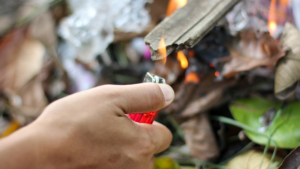
In many communities, burning waste is a daily routine, as ordinary as cooking or sweeping the front porch. Around 2.7 billion people in the world have no waste collection service at all. When there is no bin to fill, when no trash truck comes, when there is no system ready to take the problem away, waste piles up quickly – and that pile brings its own very real, very urgent consequences: rotting food, insects, blocked drains, the spread of disease. Burning solves those problems quickly, at least on the surface. This is not careless behaviour or ignorance. It is the reality of having to choose the least bad option from a very short list.
A global problem
Open burning is not limited to one region or one type of community. It is a global response to a global problem: too much plastic, most of it single-use, with no plan for where it ends up.
According to the Lloyd’s Register Foundation 2024 World Risk Poll, open burning is most widespread in Eastern Africa, where 41% of households use it as their primary method of waste disposal, followed by Central and Western Africa at 34%, and South-East Asia at 32%. In Indonesia, the number sits even higher than all of these regional averages, with 48% of households reported to burn their waste, despite open burning being prohibited by law. In rural communities across Nigeria, Kenya, Ethiopia, Ghana, Nepal, and Thailand, open burning is documented as a common household practice. In rural Thailand alone, more than half of all household waste is burned.
It also happens in places we would not expect. Open burning has been documented in Hungary, South Korea, and the United States, a reminder that this is not simply a problem of developing nations. In fact, the wealthiest countries in the world have not solved this problem either – they have largely exported it. High-income countries including Germany, the UK, the Netherlands, France, the US, Japan, and Australia have for years been shipping plastic waste abroad under the claim that it will be recycled. In 2023, Germany was the world’s largest plastic waste exporter at over 693,000 metric tons, with the UK close behind at around 615,000 metric tons. Much of that waste ends up in countries that lack the infrastructure to process it safely, where it is dumped or burned at the household and community level. Enforcement of regulations remains a major problem, with many waste exporters taking advantage of inadequate monitoring and poor border controls. The countries producing the most plastic have the least interest in dealing with where it ends up.
What actually happens when waste is burned
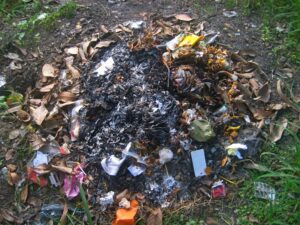
Photo credit: Abhinay Tharu/Unsplash
Burning waste does not make it disappear. It just makes it less visible, and out of sight is not the same thing as gone.
Burning waste, especially plastic, releases a toxic mix of pollutants into the air and into the soil through ash: heavy metals, styrene gas, dioxins and furans, chemicals that persist in the body and in the environment long after the fire goes out. A 2014 study published in Environmental Science & Technology found that open burning of household waste is one of the largest global sources of certain hazardous air pollutants, including polycyclic aromatic hydrocarbons and fine particles.
That last point is worth paying attention to. Fine particles known as PM2.5 are small enough to pass through the nose and throat and travel deep into the lungs and bloodstream. The WHO classifies outdoor air pollution, of which open burning is a significant contributor, as a leading environmental cause of death globally, responsible for around 3.2 million premature deaths every year.
The health impact, in numbers
The health data on open burning is difficult to read, and even harder to ignore.
One study estimated that open burning of waste is linked to between 270,000 and 920,000 deaths per year globally. Beyond that, open burning of plastics is linked to increased risks of heart disease and neurological disorders, while emissions including dioxins have been connected to skin lesions, cancer, immunological issues, and birth defects.
Sadly, this burden is not shared equally. The elderly, pregnant women, and children are among the most vulnerable. So too are the people tending the fires, and the neighbours living downwind. Harm also enters through the food chain: when toxins from burning settle into soil and water, they make their way into locally grown food and into the bodies of people who never stood near a fire at all.
The exposure does not look dramatic, but it keeps happening.
This is not large-scale burning as seen in factories or industrial incinerators. There is no towering smokestack, no warning sign, no obvious signal that something harmful is happening. There are only small fires, burning close to where people sleep, eat, and play, repeated every day, familiar enough to feel normal – and that familiarity is precisely what makes it so dangerous.
This gap is not simply a story of missing lorries and underfunded councils. It is the direct result of a production system that keeps making more plastic than the world can handle, and concentrating the consequences in the places with the least power to push back. At least 2 billion people worldwide have no access to any waste collection, treatment, or disposal services. For these communities, burning is not a choice. It is an inheritance.
The packaging problem makes everything worse. For most of human history, there was no need for large-scale waste collection. Most waste was organic, and what could be reused, reused. But single-use plastic packaging flooded markets far faster than any infrastructure could keep up, especially in island communities and rural areas where collection systems are expensive to build and even more expensive to maintain. Global municipal waste generation is projected to grow from 2.3 billion tonnes in 2023 to 3.8 billion tonnes by 2050, almost all of it driven by packaging and single-use materials landing in places that have no system in place to receive them.
And the companies that make that packaging? They have known about the problem they cause for a long time, but the burden of dealing with it has been consistently shifted, first onto public bodies, then onto households: manage it yourselves, find a way to make it disappear.
What can help, for now
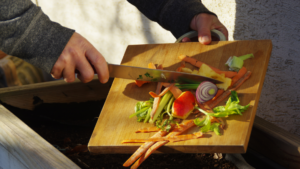
There are small changes that can reduce the harm while the larger system gets its act together. Separating organic waste for composting and keeping plastic out of the fire entirely, significantly lowers exposure to dioxins, furans, and heavy metals.
This is not a complete solution, but it is not nothing either. Reducing the most toxic emissions is one small, real part of addressing the harm, even if it cannot address the system that causes it. For someone standing in front of a pile of waste with no bin to fill and no trash trucks coming, it is worth knowing.
The bigger picture
People who burn waste are not choosing pollution. They are not choosing to harm their neighbours, their children, or themselves. They are trapped in a system that was never built for them, one that was flooded with cheap plastic packaging without any consideration of its safety, or the infrastructure available to handle it.
Waste should not be managed at the point of burning. It should be prevented at the point of design. Better collection systems can ease the immediate harm, but they are a temporary fix to a permanent flow. The only real answer is less plastic being made in the first place, and producers being held accountable for every piece they release into the world.
Until products and systems change, the harm will keep being pushed onto the people with the fewest choices, and they have already been carrying it long enough.
Join the conversation